Published November 22, 2026 · By Shane Weng, BookBright Solutions LLC
In early November, the IRS released its inflation adjustments for tax year 2027 (Rev. Proc. 2026-35). The headline is simple: the seven federal tax rates don't change. What changes is nearly every number around them: the income thresholds for each bracket, the standard deduction, the Child Tax Credit, and the limits that drive gifting, estate, and HSA planning. We put the 2026 and 2027 numbers side by side on one page.
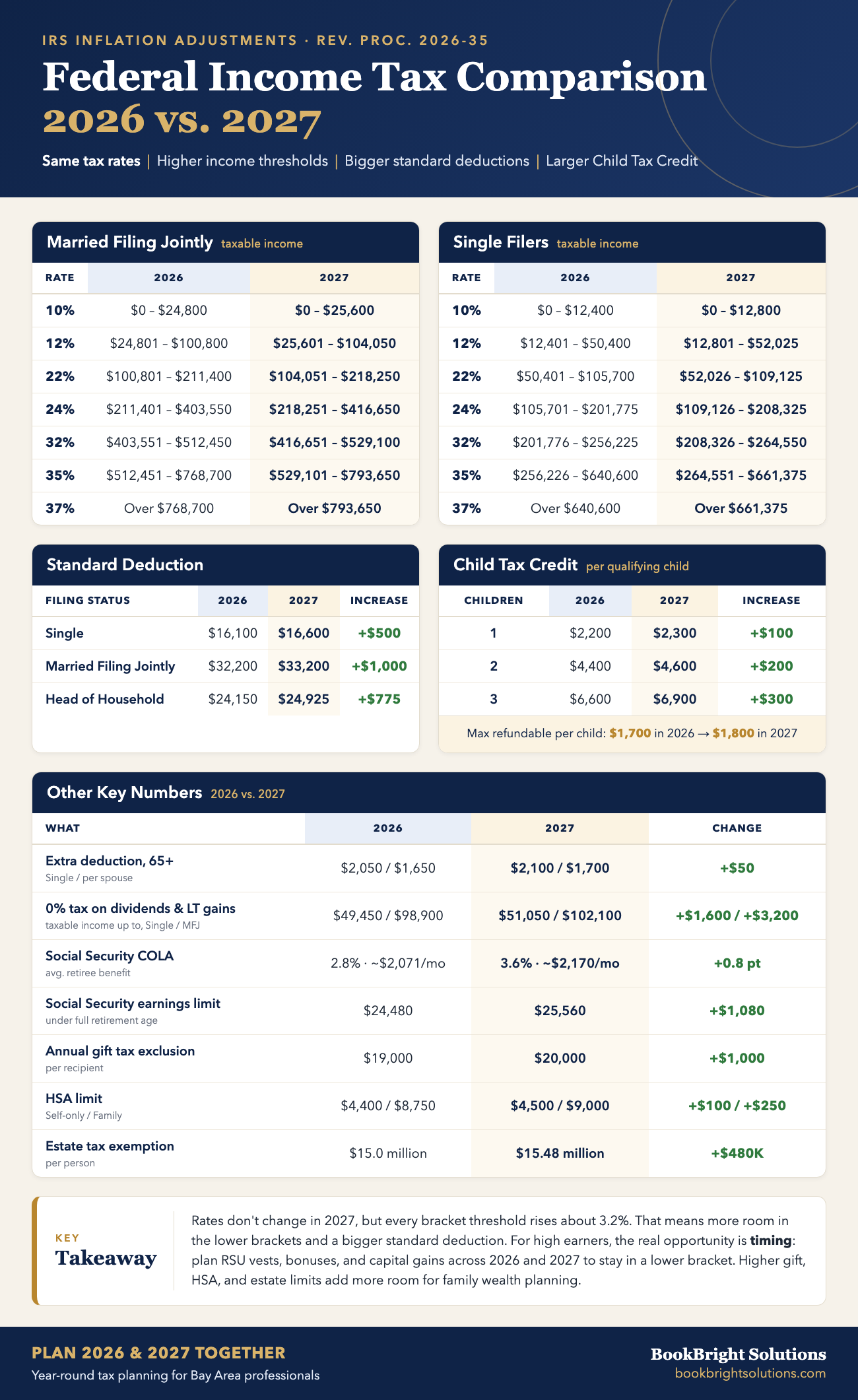
What changed for 2027
- Brackets: every threshold rises about 3.2%. For married couples filing jointly, the 24% bracket now runs up to $416,650 of taxable income, and the 37% rate starts above $793,650.
- Standard deduction: $16,600 single, $33,200 married filing jointly, $24,925 head of household.
- Child Tax Credit: $2,300 per qualifying child, with up to $1,800 refundable.
- Planning limits: the annual gift exclusion rises to $20,000 per recipient, the estate and gift exemption to $15.48 million per person, and HSA limits to $4,500 self-only and $9,000 family.
Why this matters more for high earners than it looks
For most households, a 3% bump in the brackets is a modest, automatic tax cut. For Bay Area tech households, the more important point is that 2026 and 2027 now have different thresholds. When the same dollar of income lands, which year it falls in, and what else is on that year's return can decide whether it's taxed at 24% or 32%, whether it pushes you into a deduction phase-down, or whether a capital gain lands in a lower bracket.
Where timing usually comes into play
- Equity compensation: RSU vests, ESPP sales, and option exercises that can be spread across the two years.
- Capital gains: concentrated company stock or investment sales that can be split between years.
- Family and estate planning: the higher gift exclusion and exemption change the math for gifting and longer-term wealth transfer.
None of these work the same way for every household. Whether a given move saves money depends on your full picture across both years, which is why we start with a projection rather than a rule of thumb.
Bottom line
The 2027 numbers are out, and they give high earners a bit more room. The households that benefit most are the ones that plan 2026 and 2027 together, before December 31, rather than looking at each year after it's over.
This article is general education, not individual tax advice. Figures are federal amounts for the tax years shown; California has its own brackets and rules. Planning outcomes depend on your income, filing status, equity compensation, residency, and prior-year tax picture. BookBright Solutions LLC is a tax preparation and planning practice based in San Jose, serving Bay Area tech professionals and clients nationwide.